
Trace Jefferson County Former Owners
Every chain begins at the newest recorded deed. Its grantor is usually the prior owner. Book and page references plus the legal description supply the links for the next deed search, though coverage shifts by era once older transfers leave the online index.
| Source | Years It Covers | Where Held | What It Shows |
|---|---|---|---|
| Clerk online index | August 1984 forward | County Clerk portal | Parties, instruments, dates, book/page |
| Clerk archive search | 1966 to 1984 | Archive-search route | Earlier indexed transfers |
| Deed books and microfilm | Collection-specific | Deed Room and KDLA | Older grantor-grantee links |
| Tax, entry, and map series | Collection-specific | KDLA and library | Names and land identity |
A modern chain runs through the Jefferson County Clerk index. Before 1984, you need archive search. The Kentucky Department for Libraries and Archives inventory identifies older deed, tax, will, entry, and map series for exactly that purpose.
Use Jefferson County Party Roles
Query the Clerk name search as grantor, grantee, or both. Exact and pure-alpha matching, date ranges, and instrument filters narrow the field. Search the current owner of record as grantee to locate the acquiring deed. Its grantor then becomes the next former owner in your Jefferson County chain.
Personal names are indexed as last name, first name, middle name. So search company names intact and test reasonable spelling variants. A zero result can reflect search syntax or an earlier record era. That is not the same as a missing deed.
Match the Jefferson County Tract
Repeated surnames pull Jefferson County chains onto wrong land. A legal description identifies the land in an instrument, unlike a street address, which is only a label, so compare the description, subdivision lot, deed references, and parcel context carefully. Check each step against them.
The PVA deed reference and parcel ID can orient the search, and a LOJIC map can confirm geometry. Neither replaces the recorded instrument.
See the Jefferson County Grantor-Grantee Form
This County Clerk party-name search bridges each transfer. Its seller, buyer, matching, date, and instrument controls let you narrow a backward Jefferson County deed chain step by step.
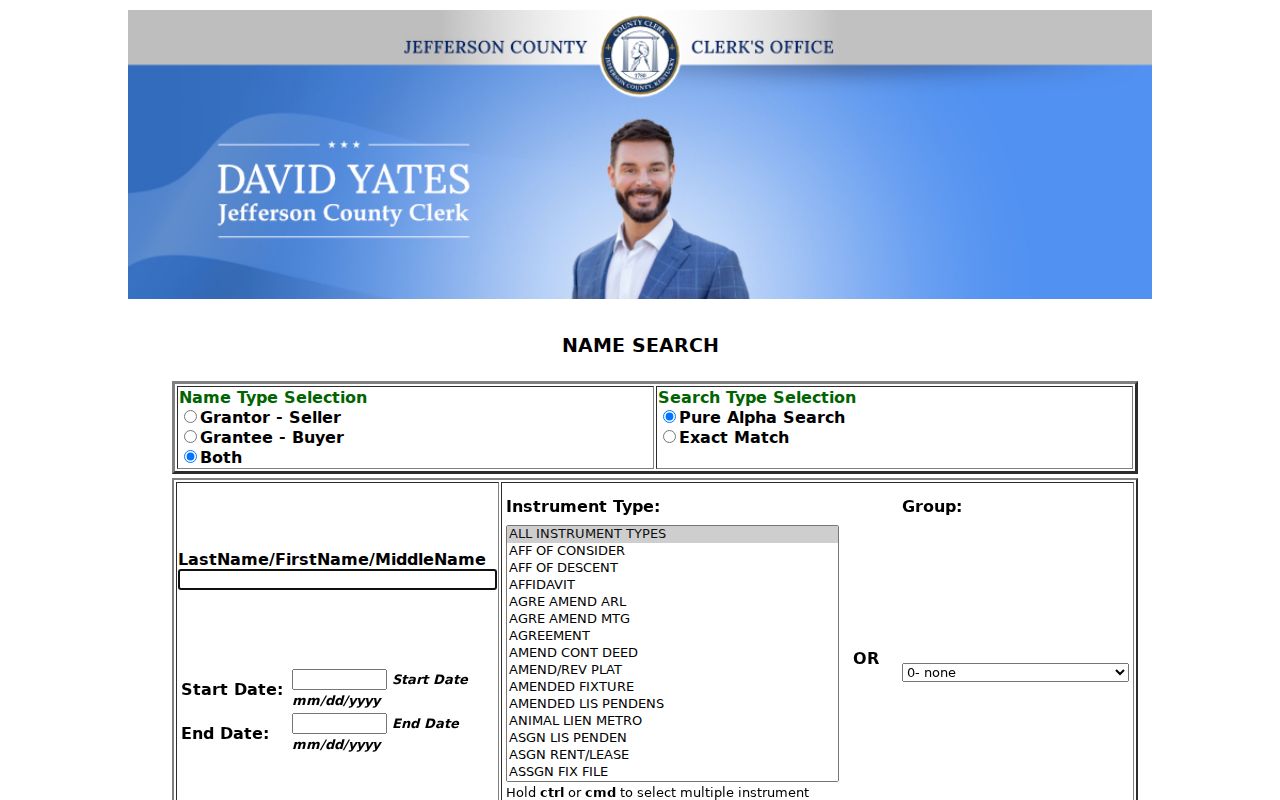
The form rewards dated party queries. Each result gets checked against the same legal description and book/page trail, which is how a former-owner search stays honest in Jefferson County.
Reconstruct Jefferson County's Deed Chain
A deed chain is the ordered sequence of transfers through which a Jefferson County interest passed. Work it backward, logging every citation.
- Find the current owner's acquiring deed and note its date, type, book/page, and grantee.
- Read the grantor and exact land description.
- Search that grantor as a grantee in an earlier date range.
- At 1984, move to archive search and deed books.
- Grantor
- The party conveying an interest.
- Grantee
- The party receiving it.
- Chain of title
- The ordered sequence of transfers.
- Reverse index
- An index used to search the opposite party role.
Cross Jefferson County's 1984 Cutoff
Online Jefferson County land records start in August 1984. Archive search covers 1966 through 1984. Earlier former owners may sit in bound deed books or microfilm, and the exact span varies by record series.
Change channels at the cutoff. Before August 1984, use archive search, the Deed Room, microfilm, and the KDLA inventory.
Bring known parties, an approximate year, and book/page clues. Asking with the land description included makes counter and archive work far more precise.
Jefferson County Plats Preserve Lots
A tract was sometimes split. An address could shift, too. Historic plats keep the ownership chain anchored through both. A plat is simply a recorded plan. It shows the lots, blocks, and streets of a subdivision as the county approved them. To use it, match the subdivision name and lot number against the description in the deed records. The parcel's layout falls into place.
Other Jefferson County sources can shore up a gap. Tax assessments, wills, entries, and maps each carry clues. Estate records matter most when property passed through probate rather than a straightforward sale. Even so, none of these should be forced into a transfer. The deed evidence itself does not support that.
Log Jefferson County Transfers
A compact transfer log keeps former-owner work auditable. For each Jefferson County property records entry, record the date, grantor, grantee, deed type, and book/page citation, then flag any uncertain links so the deed chain stays honest.
| Transfer Date | Grantor to Grantee | Deed Type | Book/Page |
|---|---|---|---|
| Newest | Prior owner to current grantee | As indexed | Current reference |
| Earlier | Earlier grantor to prior grantee | As indexed | Earlier reference |
Tax-roll continuity can corroborate a year of ownership, but only a deed chain proves the transfers ran without a break.
Jefferson County Archives Extend the Chain
Previous owners sometimes vanish from the online systems. The KDLA inventory adds real depth for Jefferson County deed records in those cases. It lists deeds on microfilm covering 1783 through 1868 and 1871 through 1910. Original record blocks fill 1869 to 1870, 1911 to 1945, and 1955 to 1966. Those spans describe what the repository holds. They are not a promise that every parcel has a complete entry every year.
An archive request works best when it is specific. Include the county, surname, approximate date, book/page, subdivision, lot, and legal-description clues already gathered. KDLA also lists older tax assessments, wills, entries, and an 1858 map series. A tax-list name or a map label stays supporting context, though. It remains that way until a deed or probate instrument ties it to the tract itself.
The Sixty Year Project Changes Access
Recent digitization work by the Clerk explains why a single search rarely covers every decade of Jefferson County property records. A state grant of $2,438,472 funded the effort, and a newer archive search launched in 2025 to extend online access back toward 1966. That is real progress. It is not a promise that every older record has left the shelf.
When an online search stalls, note the portal and the date you used it. Then call the Deed Room at (502) 574-6220 or visit Metro Hall, Room 204, during weekday hours. Staff there can steer you to the right copy category or archive route. A precise request works far better than asking for every prior owner of an address with no dates or land references attached.
Jefferson County Ownership Time Depth
No single starting year covers every Jefferson County source. Online indexes, the archive search, deed books, tax series, wills, entries, and maps each begin at different points. For one instrument copy, follow the deed records process.
Lawful use. Research former owners for house history, estates, and property diligence. Never use historical names to track, harass, intimidate, or harm anyone.
A reconstructed ownership chain is research, not a title opinion. Easements, liens, probate orders, and unrecorded interests may call for a broader title review.